
- Published 23/11/2026
Land Rovers, Bentleys and a Car That Runs on Wine: What the Royal Family Really Drives
On official duty, the Royal Family travels in two Bentley State Limousines and a small fleet of older Rolls-Royce state cars. In private, the car of choice has long been the Land Rover. Royals often drive themselves, especially on country estates such as Balmoral and Sandringham, and the family's relationship with cars is far more hands-on than most people expect.
What are the Bentley State Limousines?
In 2002, for Queen Elizabeth II's Golden Jubilee, Bentley built two State Limousines and presented them to her. They were built in Crewe, are more than six metres long and are powered by a 6.75-litre twin-turbocharged V8.
They are not stretched showroom cars. The roofline was raised and the windows enlarged so crowds could see the passengers. The rear compartment was designed so the monarch could get in and out with dignity, often in formal dress. Both cars are armoured, though the full details of their security features have never been made public.
Like other official state cars, they carry no registration plates, and they are painted in the royal claret and black. More than twenty years on, they are still in service for state occasions.
Why are Land Rovers the royal favourite?
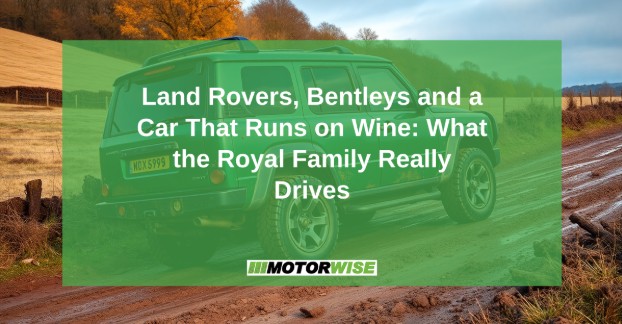
Land Rover received a Royal Warrant in 1951, only three years after the first model appeared, and it has supplied the family ever since. On the royal estates, a Land Rover suits the job: it copes with mud, carries dogs, picnic baskets and fishing rods, and does not mind being worked hard.
Queen Elizabeth II was regularly photographed behind the wheel of a Land Rover or Range Rover well into her nineties, usually in a headscarf and with a corgi or two nearby. Open-top Range Rovers have also been used for reviews and events, so the monarch can stand and be seen.
Could the Queen really drive?
Very well. In 1945, Princess Elizabeth joined the Auxiliary Territorial Service and trained as a driver and mechanic. She learned to drive heavy vehicles and to strip and rebuild engines, making her the first female member of the Royal Family to serve as a full-time active member of the armed forces.
One of the best-known royal motoring stories comes from 1998. King Abdullah of Saudi Arabia, then Crown Prince, was visiting Balmoral and was invited for a drive around the estate. He took the passenger seat expecting a chauffeur, only for the Queen to drive the Land Rover herself, briskly and chatting all the way, along the narrow Scottish estate roads. In a country where women were not allowed to drive at that time, it made quite an impression.
As the sovereign, she did not need a driving licence, and the official state cars do not need number plates. Those are two motoring perks no other driver in Britain could claim.
Did Prince Philip design his own hearse?
Yes. The Duke of Edinburgh worked with Land Rover on a modified Defender TD5 130 over many years and asked for it to carry his coffin. It was painted dark bronze green, a military colour, and fitted with an open rear platform. At his funeral in April 2021, the Land Rover he had helped design carried him to St George's Chapel at Windsor, a fitting goodbye for a man who loved engineering.
Prince Philip drove himself until the age of 97. He gave up his licence in 2019 after a collision near Sandringham while driving a Land Rover Freelander.
Which royal car runs on wine and cheese?
King Charles III was given an Aston Martin DB6 Volante for his 21st birthday in 1969, and he has kept it ever since. In 2008 it was converted to run on bioethanol made from surplus English white wine and whey left over from cheese making. It may be the most British fuel ever put in a car.
The same Aston Martin made headlines in 2011, when Prince William and Catherine drove away from Buckingham Palace in it after their wedding. It wore a joke number plate reading JU5T WED, and the back was decorated with balloons and ribbons.
Do royal cars ever get scrapped?
Very rarely. Royal vehicles are usually kept, displayed in museums or sold at auction, where ex-royal Land Rovers can fetch large sums from collectors. Most of us cannot expect our old car to end up in a museum. When yours reaches the end of the road, a licensed vehicle recycling UK network makes sure it is recycled properly, and you can get an instant scrap car quote in seconds.
The royal garage in short
On public duty, the Royal Family rides in hand-built Bentleys and stately Rolls-Royces. In private, they prefer a muddy Land Rover with the dogs in the back. From a wartime mechanic to a monarch's son running his Aston on wine, they have always liked to get behind the wheel themselves.
Frequently asked questions
What car does the King travel in on official occasions?
For state occasions, the monarch usually travels in one of the two Bentley State Limousines presented in 2002, or in one of the older Rolls-Royce state cars.
Why do royal state cars have no number plates?
The official state cars used by the monarch do not carry registration plates. It is a long-standing tradition that sets them apart from every other vehicle on British roads.
What car was used at Prince Philip's funeral?
A modified Land Rover Defender TD5 130, painted dark bronze green, which the Duke of Edinburgh had helped design himself.
